
From Iravatham Mahadevan’s book, ‘Vestiges of Indus Civilization in Old Tamil’.
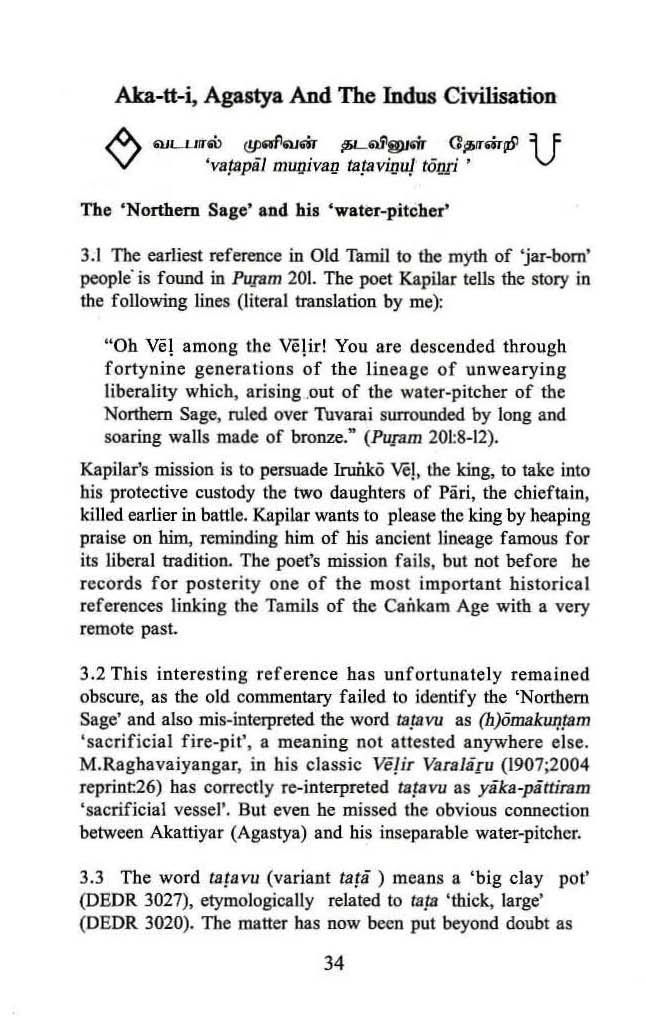

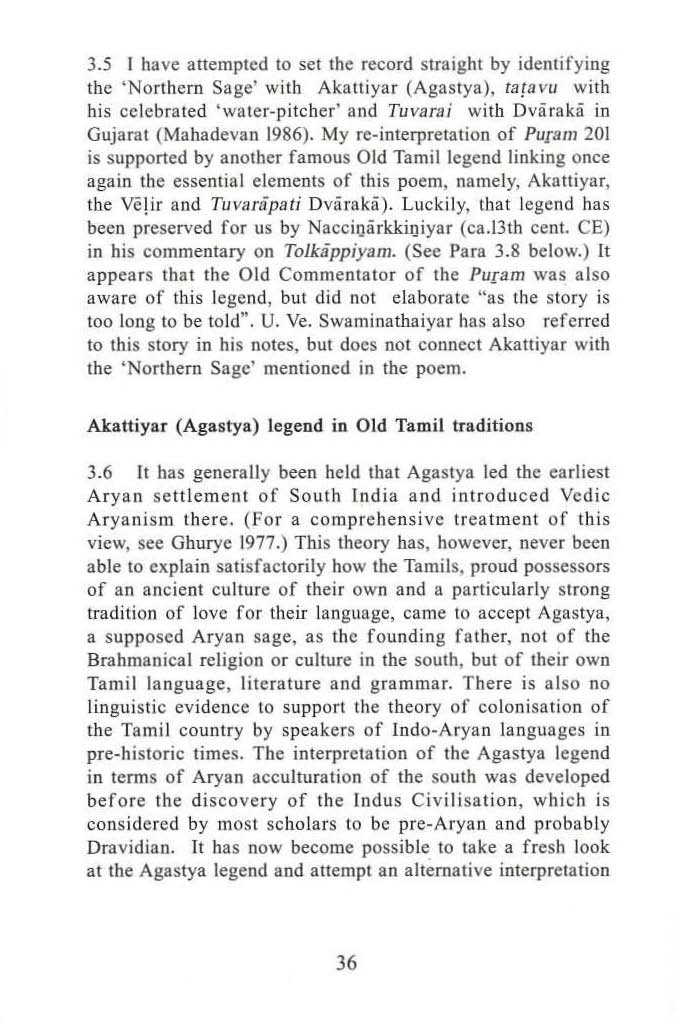
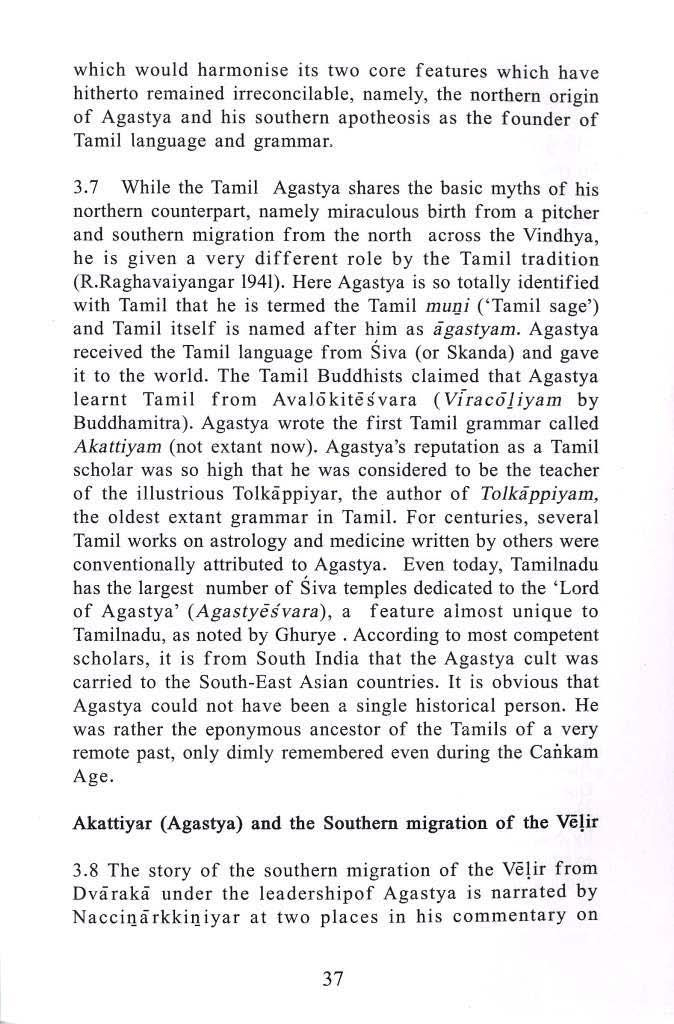
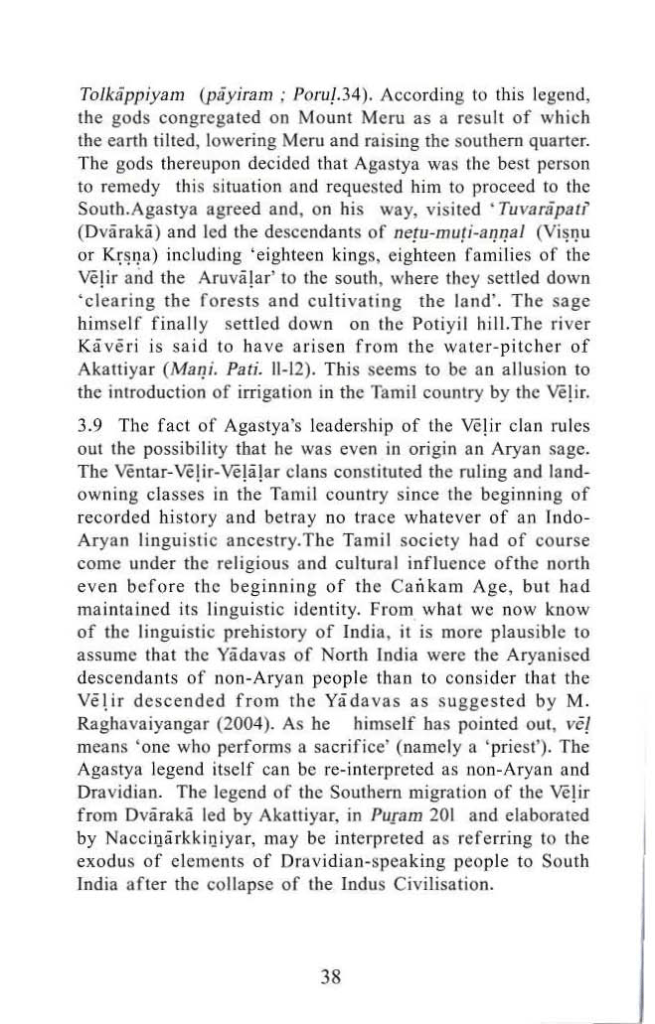
(From Iravatham Mahadevan’s ‘Dravidian Parallels in Proto-Indian Script)
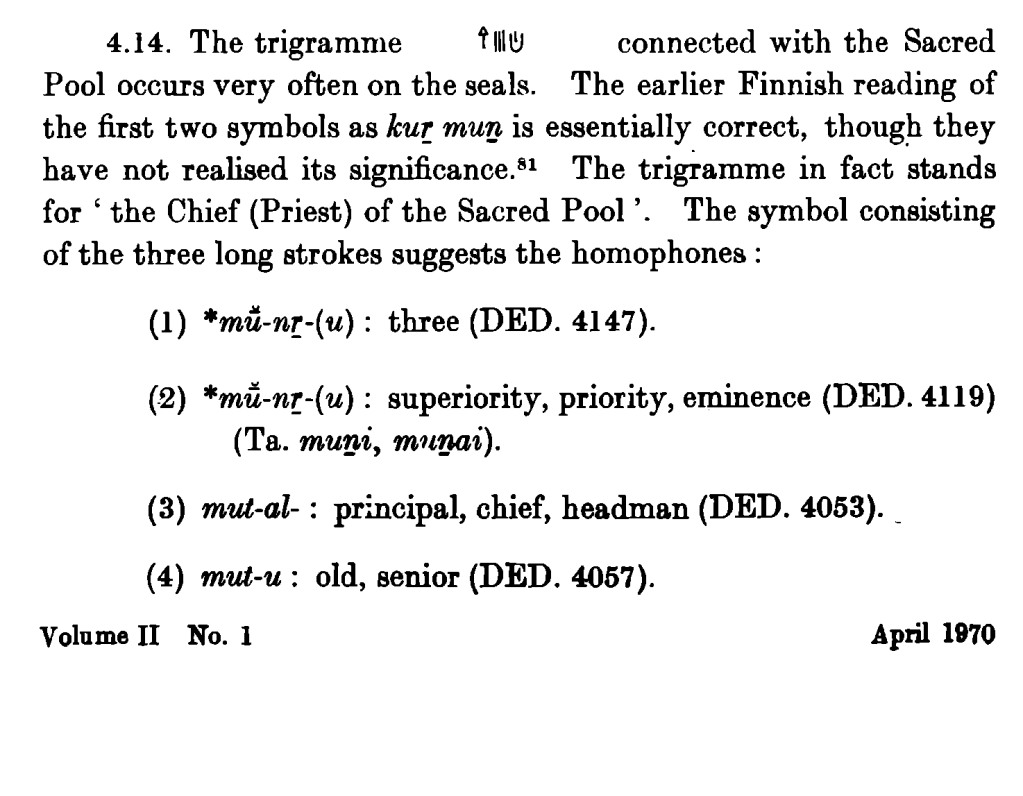
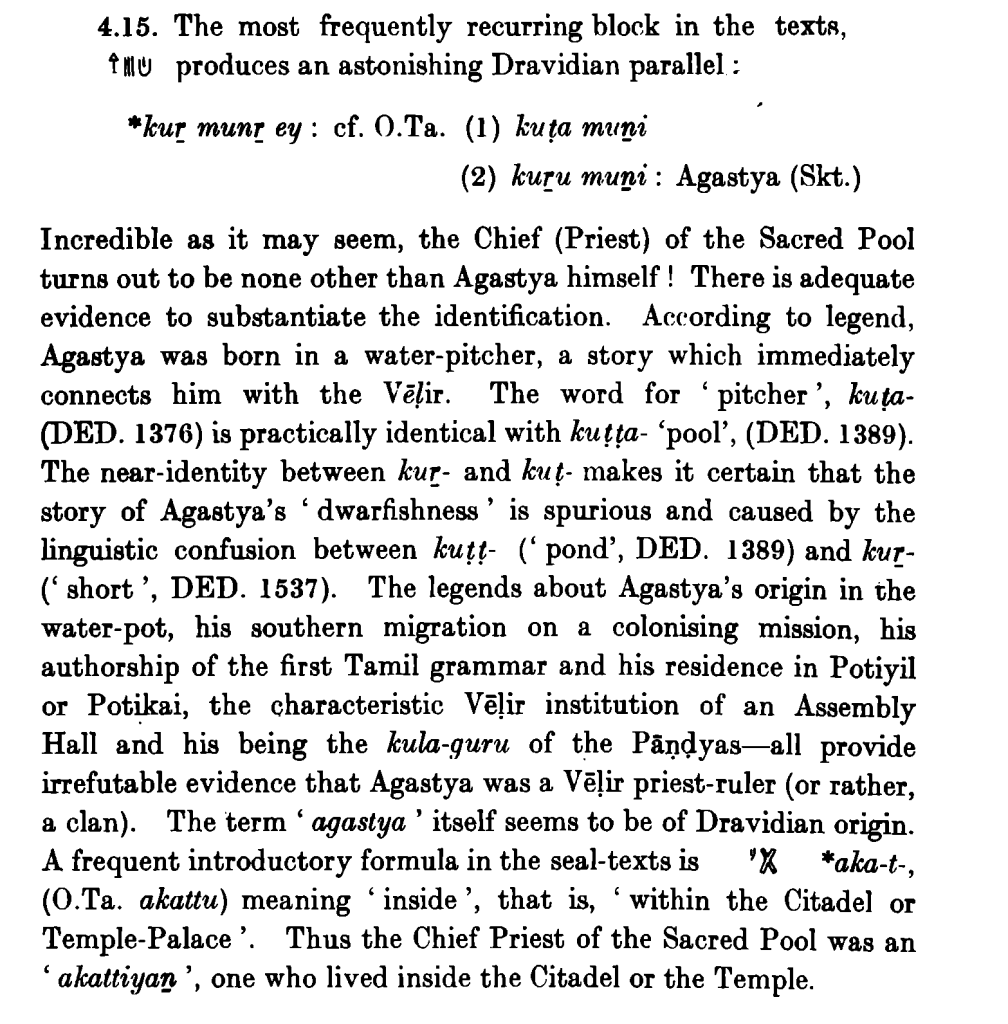
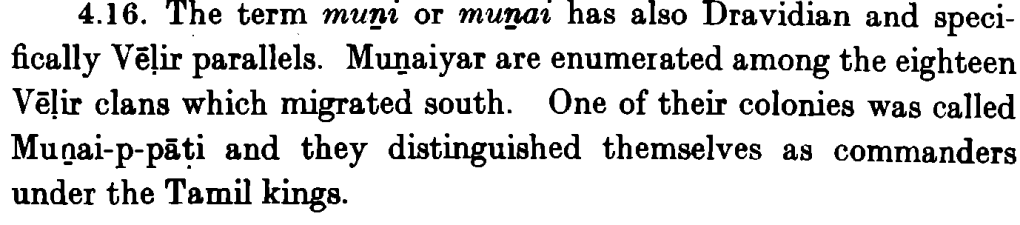

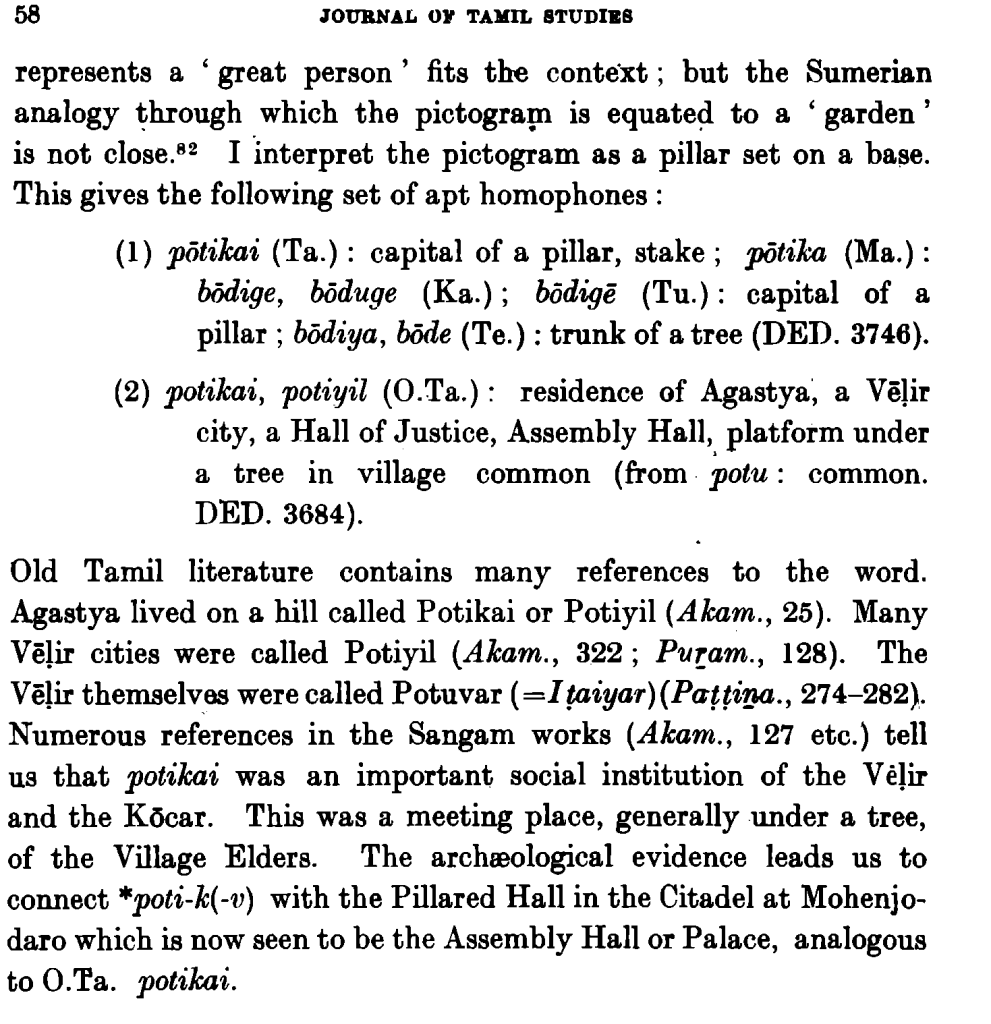
From Iravatham Mahadevan’s ‘Akam and Puram – Address Signs of the Indus Script (full essay on Roja Muthiha LIbrary site – http://rmrl.in/wp-content/uploads/42-Akam-and-Puram.pdf )
Dravidian akam :
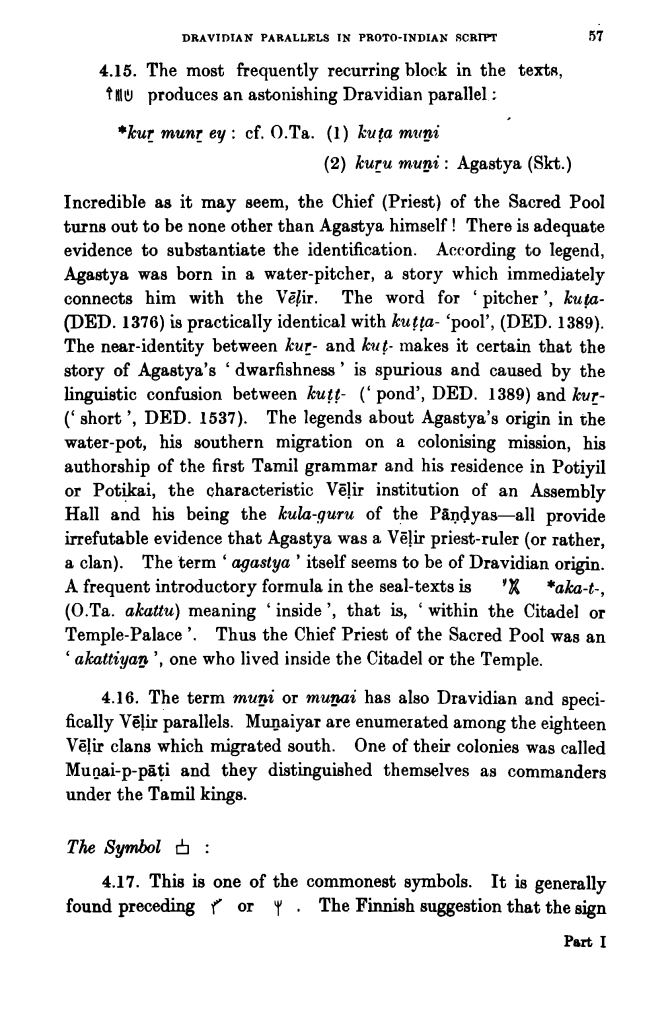
The Inner City or Citadel 2.2 The Cankam poems contain several references to akam in the sense of ‘fort, palace or inner city’. (Cf.citation at the beginning of the paper.) The critical links between Dravidian etymology and Old Tamil polity are brought out in the following two sets of references: DEDR 7: akam ‘inside, house, place’ aka-tt-u ‘within, inside the house’ akattan ‘one who is in, the householder’ Kathiraiver Pillai Dictionary (1910) : akatti : (1) akattiya munivan (‘Agastya, the sage’) (2) ull-irukkiravan (‘one who is in’) (3) oru maram (‘Agasti grandiflora’) The gloss in English within brackets has been added by me. Note Dravidian aka-tt-i > IA agasti in (1) & (3) above. Agastya and the Indus Civilisation 2.3 The migration of the ancestors of the Velir-Yadava clans led by Agastya from Dvaraka to South India in proto-historic times is the most important evidence connecting the Indus Civilisation with South Dravidian, especially Old Tamil. The earlier interpretation of the Agastya legend in terms of Aryan acculturation of the South was developed before the discovery of the Indus Civilisation which is now considered by most scholars to be pre-Aryan and Dravidian. It is now possible to attempt an alternative interpretation which would harmonise the two core features of the legend, namely the northern origin of Agastya and his southern apotheosis as the founder of Tamil language and grammar. The fact of Agastya’s leadership of the Veliir clan rules out the possibility that he was an Aryan sage. The legend of the southern migration of the Ve$l@ir may now be interpreted as referring to the exodus of Dravidian-speaking peoples to South India after the collapse of Indus Civilisation.15 Evidence from the Indus Texts 2.4 The most persuasive evidence for the akatti > agasti equivalence comes from the Indus texts themselves. Agasti (Atharva Veda) and Agastya (Rigveda) are derived from Dravidian aka-tt-i- lit., ‘he of the house’, i.e. the ruling class with its power centre in the Citadel. Agastya was known as the ‘jar-born’ sage. The ultimate source of this legend appears to be the constant association of aka-tt-i ‘one inside the House’ with the JAR sign respectively at the beginning and ending of the Indus texts as illustrated below (from left to right for convenience): aka-tt-i > agasti kumbha-muni ‘one inside the House’ (Ruler) ‘he of the water pitcher’ (Priest)
Evidence from the RV and Later Indo-Aryan
‘jar-born’ and ‘mind-born’ sages
2.5 The birth of Vasistha and Agastya is described in a famous hymn in the RV (7.33). They are said to be born of the seed of Mitra and Varuna deposited in a pitcher (kumbha) when the gods saw Urvasi, the apsaras, in a flash of lightning. Agastya especially came to be known as the ‘jar-born’ sage (kumbha-yoni, kumbha-sambhava, etc.). Vasistha is described in the hymn as ‘mind-born’ (manaso adhijatah), an epithet which presumably applies to Agastya as well, who was born along with Vasis@t@ha in the same manner. In later literature, ‘jar-born’ myths become common among Brahman@a families and Ksatriya dynasties. Similarly, all the seers, especially the seven great preceptors of the Vedas, came to be known as ‘mind-born’ (manasa$h@, manasa-putrah@, etc.). (Index to Mbh., Sorensen). We saw above how the ‘jar-born’ legends can be ultimately traced to the JAR sign of the Indus script, with which most names and titles are associated in the Indus texts. The epithet ‘mind-born’ appears to be a case of incorrect loan translation from Dravidian aka(m) which means both ‘house’ as well as ‘mind’ (DEDR 7). Cf. Ta. aka-tt-u ‘in the house’; also ‘in the mind’.
Agastya: Mana, ‘the house’
2.6 The derivation IA agasti < Dr. aka-tt-i, ‘he of the house’ is corroborated by the fact that Agastya was also called Mana in the Rig Veda (7.33.13). The latter name is supposed to mean ‘pride’. However, the term mana also occurs in the Rig Veda with the meaning ‘a house, building or dwelling’ (Monier Williams). It appears that Mana, the other name of Agastya, is the literal but unintended loan translation from Dr. aka-tt-i ‘he of the house’.
Grhapati : the Vaisya ‘householder’
2.7 The word grhapati in the RV and later is a title which means literally ‘householder’ or‘master of the house’ (Vedic Index). However, in actual usage in the early historical period, especially in Pali, the term gahapati connotes a member of the Vaisya caste, the non-Aryan land-owning and trading classes, which supported the non-Brahmanical religions of Buddhism and Jainism. The title grhapati is the source for gahapati (Pkt.), gapati or gapiti (Sinhala-Pkt.inscr.) and kavati (inscr.) or kaviti (literary) of Old Tamil. Thus, the Harappan title aka-tt-i ‘he of the house, master of the fort ’, is the ultimate source for IA grhapati and its derivatives cited above.
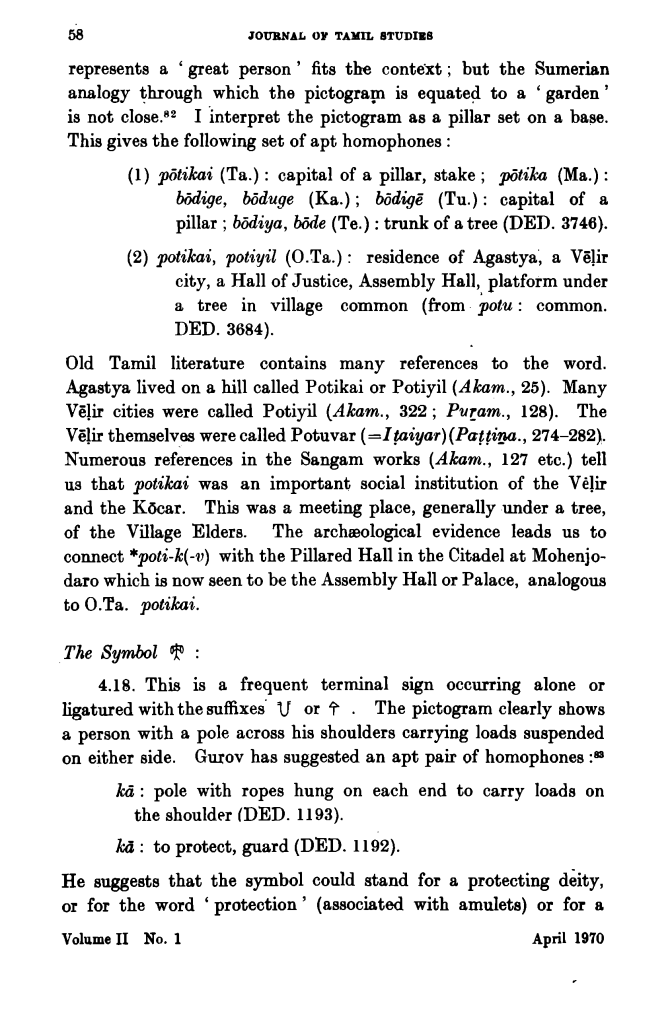
From Dravidian Parallels in Proto-Indian Script, by Iravatham Mahadevan (Found on the Roja Muthiah Library site – http://rmrl.in/wp-content/uploads/2014/02/papers/1.pdf )
 Keezhadi and the Indus Valley Civilization