Excerpts from Iravatham Mahadevan’s essay. The full essay is in the Roja Muthiah Library site – http://rmrl.in/wp-content/uploads/42-Akam-and-Puram.pdf
அகத்தோன் செல்வமும் அன்றியும் முரணிய
புறத்தோன் அணங்கிய பக்கமும் (தொல்காப்பியம், பொருள் 12)
‘The one inside (the fort) has the wealth; but the one outside, fighting, lays siege’.
0.1 This is a preliminary announcement of a new identification of a frequent ‘opening’ sign in
the Indus texts. The sign, depicting a ‘crescent moon’, is identified, through rebus, as
representing the ‘outer (city)’ and the ‘others’. I have also added, with some new evidence,
two other complementary identifications earlier proposed by me, namely, the ‘(planned) city’
and the ‘inner (city)’ or ‘citadel’, to place the new identification in proper perspective.
1. The Harappan City : ‘The City of Four Quarters’ 1.1 The Harappan city (typically, Mohenjodaro) is a meticulously planned and highly conscious architectural creation, with its grid-like streets oriented towards the four cardinal directions, and with a fortified citadel on a high artificial terrace to the west, dominating the lower city to the east. Judging from the public character of the large buildings and the so-called ‘Great Bath’ found within the citadel at Mohenjodaro, there is little doubt that the citadel was the seat of authority and ceremonial centre in the Harappan city. 1.2 The walled city of the Bronze Age was symbolised by the design of the ‘Quartered Circle’.2 This motif occurs as ‘intersecting circles’ in the characteristic Harappan ceramic design3 (Fig. 3A) . The ‘Quartered Circle’ is also the source for the Egyptian hieroglyphic ideogram for ‘city, town, village’4 (Fig.2.1) . The corresponding Indus sign depicting a ‘walled city divided by intersecting streets’ can be identified as the ‘City of Four Quarters’. The sign occurs in two variant forms, oval and rhomboid (Fig. 3B & C) . Fig.3: ‘Intersecting Circles’ and the ‘City of Four Quarters’
Pāḻi : the ‘planned city’ 1.3
It is interesting that Old Tamil and Old Kannada have preserved a Dravidian expression which connects the concepts of ‘city’ and ‘planning’: Pāḻi (Ta.) ‘city, town’ (DEDR 4112) Pāḻi (Ka.) ‘row, line, regularity, order (DEDR 4113) This is the linguistic evidence for interpreting the Indus sign, the ‘City of Four Quarters’, as pa$l\i in Dravidian. The identification is based not merely on etymology, but is also supported by frequent references in the Tamil Cankam poems to Pa$lÈi, an ancient and prosperous city of the Tamil Velir clan . It is relevant to recall here the Old Tamil tradition of migration of the Velir and allied Tamil clans led by Agastya from Dvarakato South India 6 . It is also significant that the Cankam poems refer to the presence of the Velir and Kocar clans in the Konkan and Tulu regions northwest of the Tamil country. These traditions may be interpreted as dim recollections of the migration of Dravidian-speakers to the South in protohistoric times from regions still further to the northwest like North Konkan and South Gujarat which were then included in the Harappan domains. It is suggested that the Dravidian migration to the South at the end of the Indus Civilisation is the source of the city related vocabulary preserved in the oldest layers of the Tamil Cankam poetry handed down by oral transmission at the earliest stages.
Naṉmāṭakkūṭal: the ‘City of Four Quarters’
1.4 Madurai, the capital of the Pantiyan\ kingdom and centre of Old Tamil civilisation, was also known as kuṭal or more fully as Naṉmāṭakkūṭal, traditionally interpreted as the ‘Junction of Four Terraces’.9 The description is strikingly similar to the Indus ideogram for the ‘City of Four Quarters’ (Fig.3C)
Matir-ay : the ‘Walled City’
1.5 The ancient name of Madurai was matiray as recorded in the earliest Tamil-Brahmi cave inscriptions from ca. Second Century BCE.10 The expression matir(-ay) can be interpreted in Dravidian as a ‘walled city’ on the basis of the following linguistic evidence :
DEDR 4692: matil (Ta.) ‘wall around a fort, a fortification’; matilu, matulu (Tu.) ‘roofed wall of a compound’; maduru (Te.) ‘coping of a wall’; madru goda (Konda.) ‘mud wall, compound wall’.
DEDR 4689: matalai (Ta.) ‘cornices on sides or front of house’; madil (Ko.) ‘lintel of a doorway’.
Matiray was the ‘walled city’ par excellence of the ancient Tamil country. The literary form maturai seems to have been influenced by the Northern traditions related to Mathura, with which the Tamils of the Cankam Age were familiar. I propose that Indo-Aryan mathura is itself derived from the earlier Dravidian Matir-(ay) ‘walled city’. When the Velir (Yadavas) migrated from Mathura to the coastal regions of Saurashtra, Dravidian matir-(ay was translated as Indo-Aryan dvaraka, ‘the walled city with (imposing) doorways’. Compare with kapatapuram, the Sanskrit name (with the same meaning) of an ancient Pantiyan city, probably identical with Madurai.
Burrow (1963) compiled a list of place names ending with – armaka from early Sanskrit literature and concluded that the large numbers of ruined cities which remained for centuries such conspicuous features of the countryside must have belonged to the Indus Civilisation, as the early Aryans had no large cities. He also pointed out that the non-Aryan element vaila- in the place names mentioned in the Rig Veda was probably derived from the language of the original inhabitants. I suggest, based on the evidence of the association of the ancestors of the Vēḷir with the Indus Civilisation, that the place names Vaila-sthanaka and Maha- vaila-stha in the Rig Veda seem to be hybrid loan translations from Dravidian Vēḷ-akam, ‘the place of the Vēḷir. Vel ‘to sacrifice, a sacrifice’ (DEDR 5544) > Vēḷir ‘a priest’; Vēḷir ‘a class of ancient chiefs in the Tamil country’ (DEDR 5545); akam ‘house, place, inside’ (DEDR 7).
One of the -arma(ka) names compiled by Burrow from Paniini and the Kasika commentary is Kukkutarma-, literally ‘the ruined city of the cock’. I draw attention to an Indus seal from Mohenjodaro (Marshall seal No.338) which has an inscription featuring a pair of cocks followed by the ideogram for CITY (Fig. 4A). It is not unlikely that the seal has recorded in the Indus script the original Dravidian name of the city, corresponding to IA kukkutaarma, with the ideographic suffix CITY added to it.
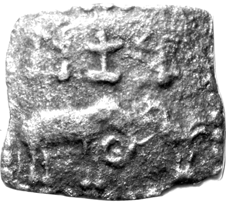
Cōḻa coin 1st century B.C.
Uraiyur, the ancient Cōḻa capital in the Cankam Age, was also known as Kōḻi, lit., ‘cock’. The name is explained by the myth of a cock boldly confronting an elephant. The myth already figures on a Co$l\a square copper coin of the Cankam Age assigned to ca. 1st Century BCE
The Harappan Inner City : The Citadel
If the Harappan city was the ‘City of Four Quarters’, the Citadel was its ‘principal Quarter’, the ‘Inner City’. The symbiotic relation between the two parts of the Harappan city is brought out clearly by a comparison of the respective ideograms: The City of Four Quarters The (Principal) Quarter, (Inner City, Citadel (Please see the full article for ideograms).
This deduction is strongly corroborated by textual analysis. The CITADEL sign followed by a superscript suffix of two strokes (most probably the oblique, genitive or locative case- marker) is, by far, the most frequent ‘opening’ or ‘address’ in the Indus texts, especially on the seals.
Dravidian akam : The Inner City or Citadel
2.2 The Cankam poems contain several references to akam in the sense of ‘fort, palace or inner city’. (Cf.citation at the beginning of the paper.) The critical links between Dravidian etymology and Old Tamil polity are brought out in the following two sets of references:
DEDR 7: aka-m ‘inside, house, place’
aka-tt-u ‘within, inside the house’
akattan ‘one who is in, the householder’
Kathiraiver Pillai Dictionary (1910) :
akatti : (1) akattiya munivan (‘Agastya, the sage’)
(2) ull-irukkiravan (‘one who is in’)
(3) oru maram (‘Agasti grandiflora’)
The gloss in English within brackets has been added by me.
Note Dr. aka-tt-i > IA agasti in (1) & (3) above.
I interpret the evidence as follows: akam is the ‘address’ of the rulers of the inner city with their seat of authority (not necessarily residence) in the citadel. They were most probably priests and warrior chiefs. puram is the ‘address’ of the residents of the outer city comprising most probably traders, skilled craftsmen and others connected with urban life. The ‘address’ signs (conventionally referred to here as akam and puram as in Old Tamil) indicate occupational and residential differentiation, apparently without any notion of superior or inferior status. This is indicated by the substantial number of seals with the ‘crescent moon’ sign depicting ‘outer city, others’ in the initial position. There are also many common names and titles in the seal-texts with either of these addresses. Still, it appears that the ‘city’ was governed from the ‘citadel’. This explains the very low frequency of the City sign in the initial position.
 Keezhadi and the Indus Valley Civilization