
(Excerpts from the article in the Journal of Tamil Studies – April 1970, by Iravatham Mahadevan – the article an be seen in full in Roja Muthiah Library Collection – http://rmrl.in/wp-content/uploads/2014/02/papers/1.pdf )
The long quest for an understanding of this script an exciting and perhaps a decisive phase with the recent publication of the preliminary achieved by the Soviet and Finnish teams of scholars working in the field. Their work has placed the investigations for the first time on a scientific basis and represents a major break-through. The methodology adopted by both teams is broadly the same. While there are differences in the identification of individual signs, as there are bound to be at this preliminary stage, both the teams are agreed on three fundamental results (a) the language is Dravidian. (b) the signs are logographic and based on the principle of homophony, and (c) the inscriptions generally read from right to left. I acknowledge my indebtness to the pioneering work of the Soviet and Finnish teams and my work should be considered as following up their break-through.
In the first place, I had no access to a computer. I have relied largely on the accurate Sign-Tables prepared by Hunter and the Sign Manuals in the original publications relating to Mohenjodaro and Harappa.
I have proceeded on the basic assumption that the material relevant to an understanding of the Proto-Indian inscriptions must be primarily Dravidian. Thus, the apparently votive inscriptions found on the ‘tiny’ seals and prisms at the lower levels of Harappa may be compared with the earliest extant Dravidian votive texts in the Tamil-Brahmi cave inscriptions. The seal texts may be compared with the earliest seal and coin legends in the Dravidian languages. The Proto-Indian graffiti stand comparison with those found on the megalithic pottery in South India. The seal-texts which presumably consists mostly of names and titles can be usefully compared with Dravidian name lists compiled from the earliest available sources, like the Tamil-Brahmi inscriptions, the poems and the colophons in the Tamil ‘Sangam’ works and from the vast material in the medieval temple inscriptions. The names of the Dravidian tribes and the Non-Aryan ethnic names preserved in early Sanskrit literature also constitute valuable comparative material. Since the archaeological evidence tells us that the Proto-Indian polity was highly organized and well-administered, it is particularly useful to collect and study the technical terminology employed in Dravidian civic administration and palace and temple organizations. Lastly, the myths and legends embodied in Dravidian literature and the oral tribal traditions may tell us much about the scenes portrayed on some of the Proto-Indian seals.
About 25% of the names in the Tamil Brahmi inscriptions and almost 40% of the names in the alphabetical list of Tamil Sangam poets begin with place names. It seemed reasonable that the proto-Indian seal texts followed a similar practice. This deduction is confirmed by the appearance of three symbols, one of which is identical to the Egyptian ideogram for a ‘city’. Starting from these premises, I was able to identify two of the symbols as representing the citadel and lower city respectively, the fundamental units of the proto-Indian polity.
Names are among the most conservative elements in any language. It appeared reasonable to look for parallels between the Proto-Indian symbols and the Dravidian symbols. The ‘fish’ symbols which comprise 10 percent of the texts and generally occur in the middle positions, seem to indicate personal names derived from planetary deities. The discovery of Heras for the words for ‘star’ and ‘fish’ (mīn, மீன்) are homophones in Dravidian languages began the whole process of decipherment. The fish symbols often occur in clusters of two or three, the most common being the pair

. The Finns have identified this pair as Saturn and Venus, and believe that it represents a planetary conjunction. I, however, have concluded from Dravidian parallels that the ‘fish’ cluster correspond to the composite personal Tamil names, so commonly found in old Tamil literature. It seems possible to employ the technique of parallelism to find a solution. We have to search for two frequently occurring Dravidian names which should satisfy three criteria:
- Linguistic connection for the words Venus and Saturn.
- Occurrence as a pair, and
- In either order
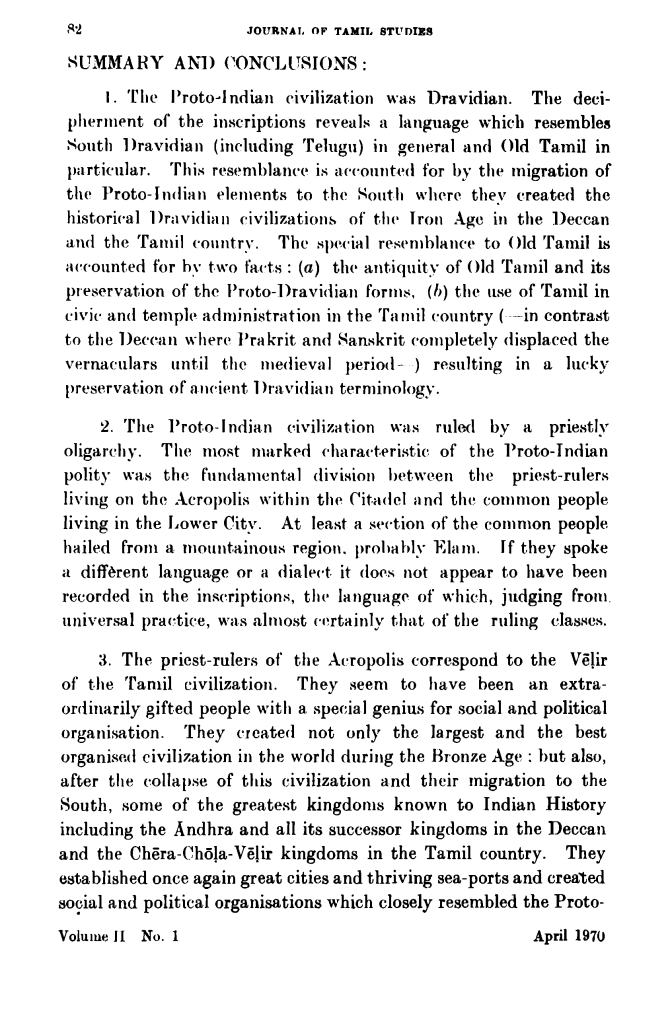
The old Tamil names ‘mā vēl’ (மா வேள்) and ‘vēl mā’ (வேள் மா) assumed by almost all the Vēlir chieftains satisfy all these criteria. Then followed the recognition that the dual meaning of vēl in Old Tamil (a chieftain; to perform a sacrifice) is a survival from the times when the priest was also a ruler in the social order which was certainly non-Aryan and pre-Aryan.
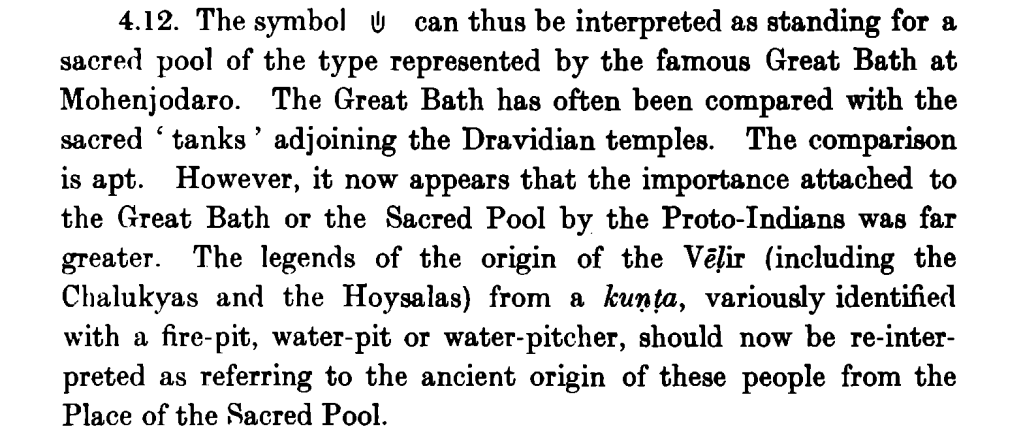
The symbol

:
The symbol which is known to occur three times in a text of six symbols (one each in the initial, medial and final positions) and which ends 30 percent of all the proto-Indian inscriptions is most unlikely to be the Dravidian genitive suffix.
The most frequently occurring element in the formation of Old Tamil names turns out to be ‘aṉ’, the masculine singular pronominal suffix of the Third Person meaning, ‘he, that man’ (அவன்). The evidence on this point is conclusive.
The corpus of the Tamil-Brahmi inscriptions contains 98 composite personal names and titles in which the suffix aṉ occurs 99 times. Twenty out of the 74 inscriptions, end with aṉ in the final position (verbal positions ending in ān, ōn are not included in this count). In a number of composite names the suffix aṉ occurs even twice or thrice e. g. maṇi-y vaṇṇakkan tēvaṉ cattaṉ.
A random sampling of the first one hundred composite names from the alphabetical list of the Sangam poets yields similar results. The suffix aṉ occurs 82 times in these names. The suffix occurs 61 times in the final position (ignoring the honorific ār, conventionally added in the colophons to the poets’ names).
In the light of this evidence from the nearest parallels, it seemed reasonable to suppose as a provisional working hypothesis, that the symbol in question probably represents the Proto-Dravidian equivalent of the masculine singular pronominal suffix of the Third Person.
The homophony, mīn (fish) = mīn (star, shine) appears so irresistible that the phonetic value of mīn has been accepted for the symbol by all scholars working within the field in the Dravidian framework. A rigorous application of the principle of parallelisms, however, show that mīn does not occur as an element in ancient Dravidian personal or clan names or titles. The element mīn does not occur in any of the Pāṇdya names. There is also no evidence for the use of mīn as an epithet affixed to Dravidian personal names in the sense ‘shining’ ‘glorious’ etc. However, the technique of parallelisms requires that we should search for a widely used name or title associated with the meaning ‘star’, ‘shine’ and which can be connected with proto-Indian names in some manner.
The clue came with the recognition that the intended homophone is probably mīṇ. It appears likely that proto-Tamil also had the miṇ form as indicated by miḷir (Ta. Lex) to shine, to glitter (ṇ>ḷ). Once the original form is recognized to be miṇ rather than min, the possibility of alternations between ḷ/ṇ/ṇṭ/ṭ. The reconstructed form is written mīḷ/ṇ/ṭ, conventionally to indicate the possible alternant form for the ‘shine’ words. The recognition of the original form for shine>star immediately leads us to the old Tamil parallel mīḷi, மீளி (DED 3990): lord, chieftain, hero, great man etc. The epithet mīḷi is derived from miḷir: to shine and is thus connected with miṇ (miṉ) form with the same meaning. The word mīḷi occurs in old Tamil as mīḷai, though the connection does not have seemed to be recognised. However, there is clear evidence for this in the alternant name mīḷi (= miḷai) pperumpatumaṉār, author of Naṟṟ 109 (மீளிப் பெரும்பதுமனார்). We should, therefore, interpret the word miḷai occurring in personal names like miḷai-k-kantaṉ-ār (மிளைக் கந்தனார்), Kuru 284, as a title forming part of the personal names and not as a name of a place.


 Keezhadi and the Indus Valley Civilization