
Excerpts from – How did the Great God get a blue neck – A bilingual Clue to the Indus Script, Journal of Tamil studies, December 2008 – The full article is in the Roja Muthiah Library site – http://rmrl.in/wp-content/uploads/2014/02/papers/31.pdf
Iravatham Mahadevan reveals the origins of Sivan in the Indus Valley Civilization.
He says the word கண்டன், which means மறவன், வீரன், went into Indo-Aryan as kaṇṭa. The word gandīra was re-borrowed into Tamil even in Cankam times (கண்டீரக்கோன் – புறநானூறு 151, கண்டீரக் கோப்பெரு நள்ளி – புறநானூறு 148, 149, 150).
Earlier, he says he took the above sign for ‘Neṭu’ meaning ‘great’. After research, he changed his view to nīḷ meaning ‘great’ ‘lofty’. நீள்குடி, great lineage (புறநானூறு 71-17).
His Words:
The two great linguistic traditions of India, Indo-Aryan and Dravidian, continually acting and reacting upon each other, add yet another dimension to the picture. The Indo-Aryan languages were influenced by the substratum Dravidian languages. The influence of the dominant Sanskritic tradition on the Dravidian languages in historical times was much greater. In this situation, it could happen that ideas which originated in Dravidian in the Harappan age, and which were borrowed by the Indo-Aryan at a very early period, travelled back to Dravidian at a much later time. In such cases, the later Dravidian concepts and words may not necessarily restore the earlier Dravidian values.
The Indian historical tradition is unique for its preservation and continuity. The Egyptian, Sumerian and Akkadian gods and heroes have long been forgotten in their countries. In India, the Vedic hymns are still chanted without missing a single syllable, and the Pre-Aryan gods are still worshipped in the temples across the country, though their names and titles have been mostly Sanskritised. This continuity is the ‘Rosetta Stone’ of the Indus script.
The suggested phonetic values and meaning of the Indus sign pair are:
Nīḷkaṇṭ(a) ‘great personage’. The phrase Nīḷkaṇṭ(a) as such is not attested in Old Tamil (for reasons 1 shall explain presently). However, the meaning of the sign pair can be readily gathered from the component words of the phrase, which, as we have seen above, are attested in Old Tamil. The significance of the phrase is Nīḷkaṇṭ (a) is that it suggests immediately IA Nīlakaṇṭha ‘god with the blue neck’ who is also mahadeva, ‘great god’ as well as sūlinl’ god with the trident’: The evidence indicates that the Harappan Dravidian Nīḷkaṇṭ (a) ‘great personage’ was borrowyd into Indo-Aryan as a loanword with only minimal phonetic changes (/.> / and, ṭ>th) Concurrently, the meaning of the Dravidian title Nīḷkaṇṭ(a) passed into Indo-Aryan as a loan translation, mahadeva, ‘great god’. Both the loanword and the loan translation refer to Siva who had emerged as the’ great god’ in this period.
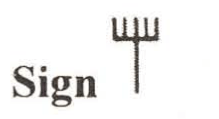
2.4 The suggestion made here is as follows: Sign

survived as a symbol in later times and its association with the meaning ‘great’ was also remembered. When Siva evolved as the ‘great god’ of the Hindu pantheon, he also acquired this symbolic attribute, which itself evolved into a weapon (trident) in his hands. The Hindu religious tradition has thus preserved in this case the ancient and hitherto unsuspected ‘ connection between the symbolism of the ‘trident’ and its original signification ‘great’. This parallelism provides a wholly independent corroboration of the meaning of

sign already suggested by its positional and functional characteristics in the Indus texts as well as by its close graphic similarity with the corresponding Sumerian ideogram with the same meaning. Here is a three-way control on the meaning of the sign, which merits serious consideration.
2.5 The evolution of sign into a symbol representing a ‘ trident’ is a post-Harappan phenomenon. It is also not necessary that the sign pair in the Indus texts referred exclusively to a divinity. It is probable that the title was in general use by the Harappan ruling classes in the same way as the
titles de-va and mahade-va occur as royal epithets or even as personal names in later times.

There are several Dravidian words for ‘great’. I had earlier considered neṭ(u) ‘great’ as in Neṭumāl ‘Vishnu’, Neṭuvēḷ ‘Murukan’, Neṭun-cēral-ātaṉ name of a Cēra king. But reading the pair as Neṭu-kanṭ(a) (1970 paras 2.48-2.49) did not prove to be productive, as the title could not be satisfactorily related to any of the traditional names or titles in Dravidian or borrowings by Indo-Aryan. It has taken me more than three decades of further search to discover that the apt word in this context is the Dravidian root of nīḷ ‘great’. Such are the occupational hazards of the would-be decipherers! A seemingly minor modification has now resulted in a major
break-through.
DEDR 3692: Tamil. Nīḷ, ‘great, loftiness’; Tulu. nēlya ‘great’.
The word n~1 ‘great’ occurs in Old Tamil:
Nīḷ eri: ‘great heat’ (Aka. 51:2)
Nīḷ kuṭi: ‘great lineage’ (Pura. 71:17)
Nīḷ niti: ‘great riches’ (Civaka. 615)
Nīḷ: ‘great’ (Pinkala. 7:2)
The suggested phonetic values and meaning of the Indus sign pair are:
Nīḷkaṇṭ(a) ‘great personage’. The phrase Nīḷkaṇṭ(a) as such is not attested in Old Tamil (for reasons 1 shall explain presently). However, the meaning of the sign pair can be readily gathered from the component words of the phrase, which, as we have seen above, are attested in Old Tamil. The significance of the phrase is Nīḷkaṇṭ (a) is that it suggests immediately IA Nīlakaṇṭha ‘god with the blue neck’ who is also mahadeva, ‘great god’ as well as sūlinl’ god with the trident’: The evidence indicates that the Harappan Dravidian Nīḷkaṇṭ (a) ‘great personage’ was borrowyd into Indo-Aryan as a loanword with only minimal phonetic changes (/.> / and, ṭ>th) Concurrently, the meaning of the Dravidian title Nīḷkaṇṭ(a) passed into Indo-Aryan as a loan translation, mahadeva, ‘great god’. Both the loanword and the loan translation refer to Siva who had emerged as the’ great god’ in this period.
However, as Nīlakaṇṭha ‘god with the blue neck’ does not correspond in meaning to mahadeva ‘great god’, the association of the loanword and the loan translation became arbitrary and conventional in Indo-Aryan and needed the invention of a myth to explain the connection.
The myth of Siva’s ‘blue neck’
3.4 The well-known myth of churning the ocean which produced both
nectar ra~rta)and poison (/d/a/a1ta)was probably already in existence and
provided the background to the new myth. Siva swallowed the poison and
Parvati (or Narayaf}a according to another version) seized Siva’s throat to
prevent him from swallowing the poison which would have destroyed the
universe. Thus the poison got stuck in Siva’s throat, turning his neck blue.
Thereafter Siva, the great god (mahJdeva), came to be called n/iaKa(l.tha ‘ god
with the blue neck’.
 Keezhadi and the Indus Valley Civilization