
(This page will be updated as more research material becomes available)
A potsherd with Tamizhi inscription:

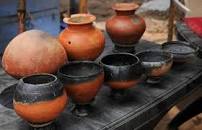
Artefacts found at Keezhadi have exposed a link with the Indus Valley Civilization. Carbon testing, a dependable scientific testing method used all over the world, has shown the samples to be from as early as 580 B.C. Carbon dating of the samples of the artefacts was done at BETA Analytic Testing Laboratory, Florida, US, while other experiments and analysis were carried out at the Geo Sciences Department of University of Pisa, Italy and PG Research Institute, Deccan College, Pune.
Significant among the findings are pots and shards of pottery with Tamil Brahmi script, skeletal remains of animals, including that of a bull with a hump, gold ornaments, iron nails and spindles for weaving and a comb made of ivory besides sharp weapons made of bones. Further, the use of bricks and mortar as well as roof tiles in the construction of houses accompanied by proper drainage facilities and wells with terracotta rings, indicate a sophisticated lifestyle. It is very close to Indus Valley Cities.
The findings are significant in that they provide material evidence to the Sangam period of Tamil literature, considered to be the golden era of Tamils. It further pushes the age of the Sangam period back to around 600 BCE, while it was previously considered to be between 200 BCE and 400 BCE. More than 15,000 artefacts have been found on the site to date.
As for the question why no evidence of industrial activity was found in Keezhadi, Amarnath Ramakrishnan who led the initial phase of excavation said, “Those who lived in Keezhadi seemed to be wealthy, sophisticated people with high purchasing power”, adding artefacts recovered were not from the region. Discovery of Tamil Brahmi inscriptions in a wide area could make one conclude that the populace were literate. Tamil Brahmi or Tamizhi were found in pot shreds inscribed by ordinary people unlike the edicts of Ashoka era which were ordered by the emperor, he claimed. The recent finds in Keezhadi have pushed history of Tamil people to 600 BC. “Only around 10 per cent of the 110-acre archaeological mound in Keezhadi has been explored so far by both ASI and State Archaeology department” he said adding only complete excavation would help reconstruct history of Tamils. Also, he welcomed the cluster approach proposed by the State archaeology department.
Amarnath Ramakrishna recalled that the team had chosen 293 sites on the Vaigai river bank for excavation, of which 100 were sites of possible human habitation. “Keezhadi is one among the hundred,” he said. “One has to remember that the mother of all races is language, and in this land it is Tamil. It has been scientifically proven. There is no use in fighting among ourselves on whether it’s Tamil culture or Dravidian heritage,” he said, adding that as Keezhadi was on a river bed it would be appropriate to call it Vaigai River Civilization. However, he noted that despite a rich collection of literature from the Sangam period, not much proper research had been done based on the literature. “This literature belongs to Tamils and we should excavate more to explore the Sangam period scientifically,” he said.
 Keezhadi and the Indus Valley Civilization