
Excerpts of the article, ‘Inscriptions and Graffiti on Pottery from Pattanam (Muciri), Kerala’ written by Iravatham Mahadevan, V. Selvakumar and K.P. Shajan, International Journal of Dravidian Linguistics June 2006. See the full article in Roja Muthiah Library site – http://rmrl.in/wp-content/uploads/26%20Inscriptions%20and%20graffiti%20from%20Muciri.pdf
Kerala was a blank space on the Early Historic archaeological map of South India but for the few sites of Roman coin hoards tin the discovery of Pattanam. Despite their significant role in the Indian Ocean trade and the references to the ports of Muziris, Bccare, Nelcynda and Tyndis in literature, archaeological evidence was lacking on the ground for the Early Historic settlements and trade activities. Thus the discovery of Pattanam (tentatively identified with ancient Muciri or Muzirs) is truly a landmark in the archaeology of Kerala. The site was first studied by Shajan and the Roman amphora from the site was identified by Roberta Tomber and the Indian ceramics were identified by Selvakumar (Shajan et al 2004; 2005). Subsequent to the discovery, trial excavations were conducted at the site by thc Centre for Heritage Studies associating the second author (Selvakumar et al 2005a, 2005b). The excavations have brought to light many interesting discoveries including an early or Sangam Age Chera coin, evidence for ‘megalithic’ (Iron Age· Early Historic Transition) occupation, inscriptions and graffiti on pottery. This paper presents a discussion and interpretation of the two inscriptions and two other graffiti found at this site.
The Site, Trenches and Cultural Periods
Pattanam lies in Paravur Taluk under Chittatukara Panchayat in Vadakkekara village of Ernakulam District. It is about 20 km north of Ernakulam, and one kilometre to the north of Paravur Thodu, a distributary of the river Periyar. The site covers 600 m. x 400 m. area and brick architecture is exposed at several dugout areas at the site.
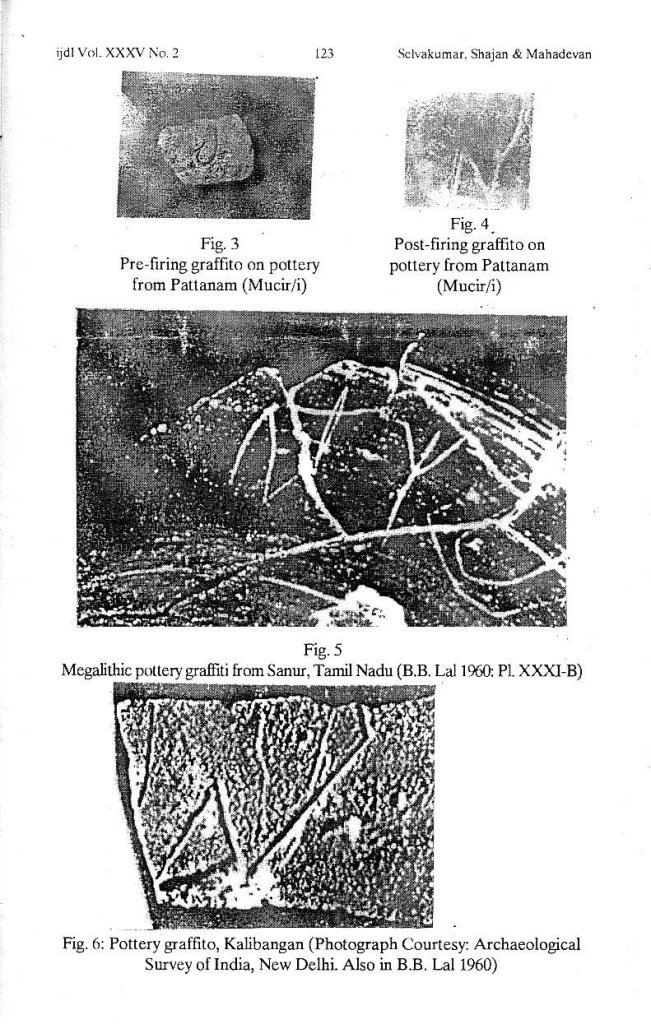
Sherds 3 & 4 (Figures 3 & 4)
Each exhibits a solitary large- sized symbol, one of them (No.3) incised before firing and the other (No.4) after. A visual comparison shows that both symbols are identical, one of them (No.3) being cursive and other (No.4) rectilinear in style.
The symbol on the sherd is easily identified by its characteristic and unmistakable shape, looking somewhat like the English capital letter ‘I’ in manuscript style. B.B. Lal (1960: symbol 47) has identified this symbol on the megalithic pottery at Sanur (sec Fig. 5) and elsewhere in Tamil Nadu.
He has compared the symbol with a sign of the Indus script incised on pottery from Kalibangan (sec Fig. 6). More recently, the same symbol has been found on megalithic pottery excavated at Mangudi in Tamil Nadu (Sheny 2003: pp. 45, 47, 48). Iravatham Mahadevan has identified this symbol with Sign Nos. 47 and 48 of the Indus script (The Indus Script, sign list, Mahadevan 1977). He has traced the evolution of this symbol from the Harappan seals and pottery graffiti to the later art motifs as well as to the megalithic graffiti of Tamil Nadu (Mahadevan 1999, 20(1). According to him, the symbol represents an anthropomorphic deity “seated on his haunches, body bent and contracted, with lower limbs folded and knees drawn up”. For a realistic representation of this symbol in human form, one may refer to the figures impressed on terracotta tiles from Harwan, Kashmir, ca. 4th cent. CE (see Fig. 7).
lravatham Mahadev<ln (1999) has identified this symbol on linguistic grounds as the earliest representation of the Dravidian deity muruku (Tamil Murukan). Cf. especially, Ta. muri ‘to bend’, Ka. muruhu, ‘a bend’, Pa. murg ‘to be bent ‘, Ga. murug ‘to bend’, Go. moorga ‘ hump-backed’, etc. (DEDR 4977). Applying the technique of rebus, the intended meaning of the symbol can be recognized from the homophonous words, Ta. murukku ‘to destroy, kill’, Ma. muruka ‘to cut’, Kol’, Nk. murk ‘to break’, Malt. murke ‘to cut into bits’, etc. (DEDR 4975). These terms reveal the original meaning of muruku ‘killer or destroyer’. As P.L. Samy (1990: 9-]6) has pointed out, this is the
meaning of the word muruku in the earliest layer of Tamil Cankam poetry. In Tamil Nadu, this symbol occurs on pottery of the Iron Age (Megalithic) assigned broadly to the second half of the first millennium BCE. The reported occurrence of this symbol at Pattanam (Mucir/i) as late as in the early medieval period is surprising and may be due to the site being disturbed. Further excavations will hopefully shed more light on the chronology of this symbol. In any case, the occurrence of this symbol on pottery at Mucir/i in Kerala is a major discovery in the chain linking the signs of the
Indus script with the ‘megalithic’ graffiti of South India.
 Keezhadi and the Indus Valley Civilization